We’re excited to be working with Help and Kindness (Feeding Dorset Partnership), Dorset Climate Action Network (DCAN), Bridport Food Matters (Sustainable Food Place) and One Health Enterprise Network (OHEN) to develop a collective bid to the National Lottery Climate Action Fund: Food Systems (CAF).
Our aims with this bid, is to connect, support and establish people groups and organisations together for a future Dorset food system which is healthier, fairer, more accessible and has greater resilience than today.
We have collated responses from a range of discussions and engagements on food from a myriad of organisations, such as businesses, farmers, community groups and local residents including our Food Conversations , our annual forum 2025, discussions to support the bid to become a Sustainable Food Place and some new survey’s led by Help and Kindness.
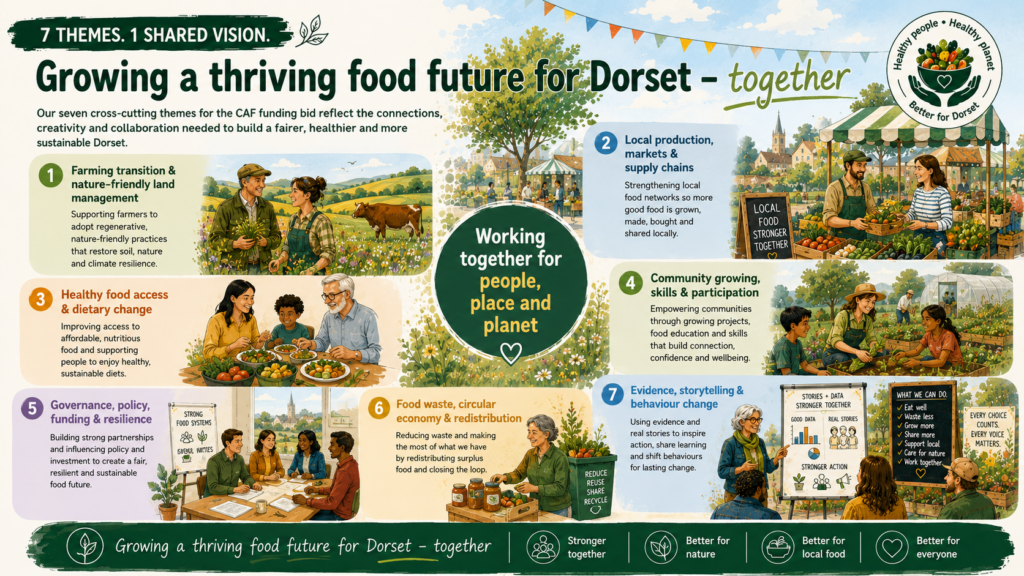
From this collation of ideas (led by Help and Kindness) seven these have emerged:
1. Farming Transition and Nature-Friendly Land Management – Supporting farmers and growers to build resilient businesses while improving soil health, biodiversity, water management and climate resilience.
Participants consistently recognised the importance of supporting farmers and growers as they respond to climate change, nature recovery and changing patterns of food production. Many highlighted opportunities to strengthen regenerative farming, improve soil health, increase biodiversity, develop agroforestry, improve water management and support resilient farming businesses.
2. Local Production, Markets and Supply Chains – Strengthening Dorset’s local food economy through local markets, procurement, food hubs and resilient supply chains.
Across all three evidence sources there was strong support for strengthening Dorset’s local food economy by improving opportunities for producers to sell locally, increasing public procurement of local food, developing local food hubs and improving routes to market.
3. Healthy Food Access and Dietary Change – Improving access to affordable, nutritious food alongside cooking skills, food education and healthier diets.
Participants frequently linked food systems with health, wellbeing and inequality. Affordable healthy food, cooking skills, nutrition, food education and community meals were all seen as important elements of a resilient food system.
4. Community Growing, Skills and Participation – Helping people become active participants through community growing, volunteering, education and neighbourhood food projects.
Many contributors emphasised the importance of enabling people to become active participants in the food system rather than simply consumers. Community gardens, allotments, orchards, volunteering, education and intergenerational learning were all seen as opportunities to strengthen communities while improving food resilience.
5. Governance, Policy, Funding and Resilience – Building stronger partnerships, aligning strategies and attracting investment for long-term change.
The evidence consistently highlighted the importance of effective leadership, long-term collaboration and sustainable investment. Contributors recognised that achieving meaningful change will require organisations to work together, share learning and coordinate resources more effectively.
6. Food Waste, Circular Economy and Redistribution – Preventing waste, redistributing surplus food and making better use of resources through a circular food system.
Reducing food waste was identified as an opportunity to deliver environmental, social and economic benefits simultaneously. Participants suggested a range of initiatives to improve redistribution, composting, local processing and the reuse of surplus food.
7. Evidence, Storytelling and Behaviour Change – Sharing learning, celebrating success and inspiring more people to become part of Dorset’s food future.
Many participants recognised that successful food system change depends on helping people understand why change matters. There was strong support for sharing evidence, celebrating success, communicating positive stories and building public confidence in local food systems.
We jointly held a webinar in July to introduce the themes – watch it here.
The themes identify areas that can be better synthesised for greater collaboration and delivery across our county and communities – our hope is to create a long term plan that ensures issues are addressed, solutions are worked from the ground up with the people connected to them most – and our current stage of focus is conversation. Hearing from as many people and communities as possible to ensure a level of understanding that further cements our action plan for the bid.
We welcome any additional feedback and hear about project ideas by 23 August, which you can give by completing this survey. If there’s something we’ve missed, or if you know of a project, organisation or opportunity that should be part of this work, please tell us through the survey or contact the Feeding Dorset Partnership team.
We will add more updates here as the bid develops.